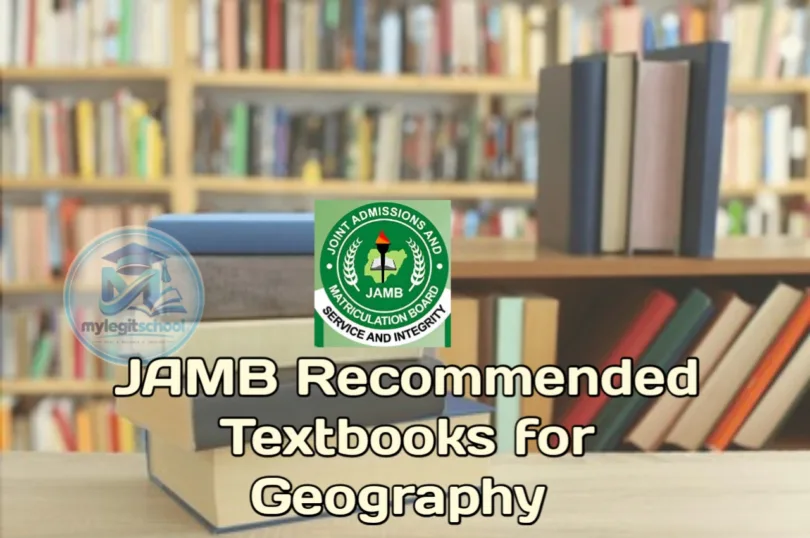
Correct JAMB Recommended Textbooks for Geography 2026/2027
Are you searching for the JAMB Recommended Textbooks for Geography 2026/2027? If you are preparing for the 2026/2027 Unified Tertiary Matriculation Examination (UTME), using the right Geography textbooks alongside the official JAMB syllabus can help you organise your study and cover the required areas effectively.
Geography is an important UTME subject for candidates seeking admission into courses such as Geography, Geology, Environmental Management, Urban and Regional Planning, Estate Management, Education, Agriculture, Tourism and Hospitality Management, and other related programmes.
One of the common mistakes candidates make is studying Geography without first checking the syllabus. A good textbook may contain much more information than JAMB requires. The best approach is to use the official syllabus as your guide and then use recommended textbooks to understand the topics.
The Joint Admissions and Matriculation Board (JAMB), through its Integrated Brochure and Syllabus System (IBASS), provides the official Geography syllabus and recommended texts. The current official syllabus contains 14 recommended Geography texts.
This article provides the complete list of JAMB Recommended Textbooks for Geography 2026/2027, details of the recommended books, important Geography topics to study, tips for choosing your textbooks and an effective preparation strategy.
Important: Recommended textbooks are study resources. They do not guarantee the exact questions that will appear in JAMB. Candidates should always use the current official JAMB syllabus as their primary study guide.
JAMB Recommended Textbooks for Geography 2026/2027
According to the official JAMB Geography syllabus, the following books are listed under Recommended Texts:
- Certificate Physical and Human Geography for Senior Secondary School (West African Edition) — B. O. Adeleke, O. Areola and G. C. Leong
- Contemporary World Regional Geography — M. Bradshaw et al.
- General Geography in Diagrams for West Africa — R. B. Bunet and P. O. Okunrotifa
- Collins New Secondary Atlas — Macmillan
- Introduction to Geography — D. Fellman et al.
- Introduction to Geography — A. Getis et al.
- A New Geography of West Africa — N. P. Iloeje
- A New Geography of Nigeria — N. P. Iloeje
- Map Reading of West Africa — D. A. Nimako
- A Regional Geography of Africa — P. O. Okunrotifa and S. Michael
- Geographical Regions of Nigeria — R. K. Udo
- Geography: An Integrated Approach — D. Waugh
- Wisdomline Pass at Once JAMB
- A Comprehensive Text on Physical, Human and Regional Geography — M. A. Adegoke
These titles are listed in the Recommended Texts section of the official JAMB Geography syllabus.
Complete List of JAMB Geography Recommended Textbooks 2026/2027
1. Certificate Physical and Human Geography for Senior Secondary School
Authors: B. O. Adeleke, O. Areola and G. C. Leong
Edition: West African Edition
Year: 2002
Publisher: Oxford, Ibadan
This is one of the recommended Geography textbooks listed in the official JAMB syllabus.
The book covers both physical and human geography, making it useful for candidates who want a broad understanding of the subject.
It can be used to study concepts involving the physical environment as well as human activities and their relationship with geographical factors.
2. Contemporary World Regional Geography
Author(s): M. Bradshaw et al.
Year: 2004
Publisher: McGraw Hill, New York
This textbook focuses on regional Geography and can be useful when studying geographical patterns across different parts of the world.
Candidates can use it to strengthen their understanding of regional differences, human activities, resources, population and geographical relationships.
3. General Geography in Diagrams for West Africa
Authors: R. B. Bunet and P. O. Okunrotifa
Year: 1999
Publisher: Longman
This book is particularly useful for candidates who learn better through diagrams and illustrations.
Geography contains many concepts that are easier to understand when presented visually. Candidates can use diagrams to understand physical features, processes and geographical relationships.
4. Collins New Secondary Atlas
Publisher: Macmillan
An atlas is an important resource for Geography students because Geography involves understanding locations, regions, boundaries, physical features and spatial patterns.
Candidates should learn how to interpret maps rather than simply memorising the names of places.
An atlas can also be useful when studying Nigeria, Africa and the wider world.
5. Introduction to Geography
Authors: D. Fellman et al.
Edition: Seventh Edition
Year: 2005
Publisher: McGraw Hill, New York
This textbook provides an introduction to geographical concepts and can serve as a general reference for candidates preparing for UTME.
Use it alongside the JAMB syllabus to identify the relevant sections to study.
6. Introduction to Geography
Authors: A. Getis et al.
Edition: Ninth Edition
Year: 2004
Publisher: McGraw Hill, New York
This is another general Geography textbook included in JAMB’s recommended-text list.
It can be used as a supplementary resource when studying geographical concepts, spatial relationships, physical environments and human activities.
7. A New Geography of West Africa
Author: N. P. Iloeje
Year: 1999
Publisher: Longman
This textbook focuses specifically on the Geography of West Africa.
It can be useful when studying topics relating to:
- West African countries
- Physical features
- Climate
- Vegetation
- Population
- Natural resources
- Economic activities
- Regional differences
Candidates preparing for JAMB should pay attention to West African and African regional Geography.
8. A New Geography of Nigeria
Author: N. P. Iloeje
Year: 1982
Publisher: Longman
This book focuses on the Geography of Nigeria.
It can be particularly useful when studying Nigeria’s:
- Physical features
- Climate
- Vegetation
- Drainage
- Population
- Natural resources
- Agriculture
- Industries
- Transportation
- Regional divisions
Nigerian Geography should receive serious attention because Nigeria forms a major part of the regional Geography component of the syllabus.
9. Map Reading of West Africa
Author: D. A. Nimako
Year: 2000
Publisher: Longman
Map reading is one of the areas candidates should practise extensively.
This recommended textbook focuses on map reading and can help students develop skills in interpreting geographical maps.
Areas to practise include:
- Scale
- Direction
- Bearings
- Distance
- Grid references
- Contours
- Relief
- Drainage
- Settlement patterns
- Map symbols
Do not simply read about map work. Practise it regularly.
10. A Regional Geography of Africa
Authors: P. O. Okunrotifa and S. Michael
Edition: New Edition
Year: 2000
Publisher: Longman
This book focuses on the Geography of Africa.
It can be useful for studying:
- African regions
- Physical features
- Climate
- Vegetation
- Population
- Resources
- Agriculture
- Industries
- Transportation
- Regional economic activities
Candidates should understand geographical patterns rather than relying entirely on memorisation.
11. Geographical Regions of Nigeria
Author: R. K. Udo
Year: 1970
Publisher: Longman
This is another recommended text focused on Nigeria.
It can be used to strengthen your understanding of Nigeria’s geographical regions and the physical and human characteristics associated with them.
When using older textbooks, always compare the material with the current JAMB syllabus.
12. Geography: An Integrated Approach
Author: D. Waugh
Edition: Second Edition
Year: 1995
Publisher: Nelson
This textbook provides a broad approach to Geography.
It can serve as a useful supplementary resource for candidates who want to understand relationships between physical processes, human activities and the environment.
13. Wisdomline Pass at Once JAMB
Title: Wisdomline Pass at Once JAMB
This is also included in the recommended-text section of the official JAMB Geography syllabus.
Candidates can use examination-focused materials such as this for additional revision and practice.
However, practice materials should complement—not replace—the official syllabus and comprehensive textbooks.
14. A Comprehensive Text on Physical, Human and Regional Geography
Author: M. A. Adegoke
Year: 2013
This textbook brings together the major branches of Geography, including:
- Physical Geography
- Human Geography
- Regional Geography
Because of its broad coverage, it can be useful for candidates who want one resource that covers several areas of the subject.
JAMB Geography Recommended Textbooks at a Glance
| No. | Recommended Textbook | Author/Publisher |
|---|---|---|
| 1 | Certificate Physical and Human Geography for Senior Secondary School | Adeleke, Areola & Leong |
| 2 | Contemporary World Regional Geography | Bradshaw et al. |
| 3 | General Geography in Diagrams for West Africa | Bunet & Okunrotifa |
| 4 | Collins New Secondary Atlas | Macmillan |
| 5 | Introduction to Geography, 7th Edition | Fellman et al. |
| 6 | Introduction to Geography, 9th Edition | Getis et al. |
| 7 | A New Geography of West Africa | N. P. Iloeje |
| 8 | A New Geography of Nigeria | N. P. Iloeje |
| 9 | Map Reading of West Africa | D. A. Nimako |
| 10 | A Regional Geography of Africa | Okunrotifa & Michael |
| 11 | Geographical Regions of Nigeria | R. K. Udo |
| 12 | Geography: An Integrated Approach | D. Waugh |
| 13 | Wisdomline Pass at Once JAMB | Wisdomline |
| 14 | A Comprehensive Text on Physical, Human and Regional Geography | M. A. Adegoke |
The list above follows the recommended texts shown in the official JAMB Geography syllabus.
Do I Need All 14 JAMB Geography Textbooks?
No.
Candidates do not need to purchase and read all 14 books from beginning to end.
Trying to study 14 textbooks simultaneously can make your preparation unnecessarily difficult.
A better approach is to select resources according to your needs.
For example:
Main Geography Textbook
Choose one comprehensive textbook covering physical, human and regional Geography.
Map Reading Resource
Use Map Reading of West Africa for focused map-work practice.
Atlas
Keep an atlas available for locating countries, cities, rivers, mountains, regions and other geographical features.
Nigerian Geography Textbook
Use A New Geography of Nigeria or Geographical Regions of Nigeria for Nigerian regional Geography.
Practice Material
Use examination-focused materials for revision and objective-question practice.
JAMB Geography Syllabus 2026/2027
The official JAMB Geography syllabus is more important than simply collecting textbooks.
The syllabus helps candidates understand the areas and objectives they are expected to prepare for.
The subject broadly covers Practical Geography, Physical Geography, Human Geography and Regional Geography. The official syllabus includes areas relating to map work, the physical environment, human activities and regional studies.
A useful study pattern is:
Syllabus → Textbook → Notes → Maps/Diagrams → Practice Questions → Revision
This method can make your preparation more organised.
Important JAMB Geography Topics to Study
Candidates should study the complete official syllabus rather than relying on predicted questions.
Some major areas include:
- The Earth and the solar system
- The Earth as a planet
- Rocks and minerals
- Landforms
- Weather and climate
- Vegetation
- Soils
- Water bodies
- Environmental resources
- Population
- Settlement
- Transportation
- Agriculture
- Mining
- Manufacturing
- Trade
- Tourism
- Environmental problems
- Map reading
- Nigeria
- West Africa
- Africa
- Global geographical regions
Always check the official syllabus for the detailed objectives and scope.
1. Practical Geography and Map Reading
Map reading is one of the areas where regular practice can make a major difference.
Study:
- Map scales
- Linear scales
- Representative fractions
- Distance calculation
- Direction
- Bearings
- Grid references
- Conventional signs
- Contours
- Relief
- Drainage
- Settlement
- Vegetation
- Interpretation of topographical maps
Do not only read the theory.
Get a map and practise identifying features and calculating distances.
2. The Earth and the Solar System
Study:
- Shape of the Earth
- Rotation
- Revolution
- Latitude
- Longitude
- Time
- Seasons
- The solar system
- Earth’s position in space
Understand how the movement of the Earth produces geographical effects.
3. Rocks and Minerals
Study:
- Igneous rocks
- Sedimentary rocks
- Metamorphic rocks
- Rock cycle
- Mineral resources
- Uses of minerals
Learn how different rocks are formed and where they are commonly associated with different processes.
4. Landforms
Study the major processes responsible for shaping the Earth’s surface.
These include:
- Weathering
- Erosion
- Deposition
- Volcanism
- Folding
- Faulting
Also study major landforms associated with these processes.
5. Weather and Climate
This is an important area of Physical Geography.
Study:
- Temperature
- Rainfall
- Humidity
- Atmospheric pressure
- Wind
- Sunshine
- Clouds
- Weather instruments
- Climate classification
- Factors affecting climate
Learn how geographical factors influence climate from one region to another.
6. Vegetation
Study:
- Forest vegetation
- Grassland
- Savanna
- Desert vegetation
- Factors affecting vegetation
- Characteristics of vegetation zones
- Human influence on vegetation
Pay attention to the relationship between climate and vegetation.
7. Soil
Study:
- Soil formation
- Soil profile
- Soil types
- Soil properties
- Soil erosion
- Soil conservation
- Factors affecting soil formation
Understand how soil supports agriculture and other human activities.
8. Population Geography
Study:
- Population distribution
- Population density
- Population growth
- Birth rate
- Death rate
- Migration
- Population problems
- Population policies
Learn how population characteristics vary between regions.
9. Settlement
Study:
- Rural settlement
- Urban settlement
- Settlement patterns
- Settlement functions
- Urbanisation
- Problems of urban areas
Understand why people settle in particular locations.
10. Agriculture
Study:
- Types of agriculture
- Subsistence agriculture
- Commercial agriculture
- Plantation agriculture
- Factors affecting agriculture
- Agricultural regions
- Agricultural problems
- Agricultural development
For Nigerian Geography, pay attention to important crops and agricultural regions.
11. Natural Resources
Study:
- Mineral resources
- Water resources
- Forest resources
- Soil resources
- Energy resources
- Conservation
Understand their distribution, uses and problems associated with their exploitation.
12. Transportation
Study:
- Road transport
- Rail transport
- Water transport
- Air transport
- Pipelines
- Factors affecting transportation
- Importance of transportation
- Problems of transportation
Transportation is important in understanding economic development and regional interaction.
13. Manufacturing and Industry
Study:
- Types of industries
- Factors affecting industrial location
- Industrial regions
- Raw materials
- Labour
- Markets
- Energy
- Transportation
- Industrial problems
Try to understand why particular industries are located in particular areas.
14. Trade
Study:
- Local trade
- International trade
- Regional trade
- Imports
- Exports
- Trade routes
- Trade organisations
- Major commodities
- Factors affecting trade
Understand the geographical factors that influence trade between regions.
15. Tourism
Study:
- Meaning of tourism
- Tourist attractions
- Tourist centres
- Benefits of tourism
- Problems of tourism
- Tourism development
Nigeria and Africa have several geographical features and cultural attractions that can be studied under regional Geography.
16. Environmental Problems
Study issues such as:
- Soil erosion
- Desertification
- Deforestation
- Flooding
- Pollution
- Drought
- Climate-related problems
- Conservation
Understand the causes, effects and possible solutions to environmental problems.
17. Geography of Nigeria
Nigerian Geography deserves special attention.
Study:
- Location and size of Nigeria
- Political divisions
- Physical features
- Relief
- Drainage
- Climate
- Vegetation
- Soils
- Population
- Migration
- Natural resources
- Agriculture
- Industries
- Transportation
- Regional divisions
The official syllabus specifically includes the broad outline of Nigeria as part of Regional Geography.
18. Geography of Africa
Study:
- Major physical features
- Climate
- Vegetation
- Population
- Natural resources
- Agriculture
- Industries
- Transportation
- Regional differences
- Economic activities
Use maps to locate important geographical features and countries.
How to Prepare for JAMB Geography 2026/2027
1. Start With the Official Syllabus
Do not begin your preparation by randomly opening a textbook.
Get the current JAMB Geography syllabus and use it as your checklist.
2. Choose a Main Textbook
Select one textbook that explains Geography clearly.
3. Use an Atlas
Geography requires knowledge of location, direction and spatial relationships.
4. Practise Map Reading
Map work should be practised regularly.
5. Make Short Notes
Write down important:
- Definitions
- Processes
- Examples
- Locations
- Differences
- Geographical terms
6. Use Diagrams
Diagrams can make physical Geography easier to understand.
7. Practise Questions
After completing a topic, solve objective questions on that topic.
8. Revise Regularly
Do not wait until shortly before the examination before revising.
JAMB Geography Study Timetable
Here is a sample 14-week JAMB Geography study timetable:
| Week | Main Area |
|---|---|
| Week 1 | Earth, solar system, latitude and longitude |
| Week 2 | Rocks, minerals and landforms |
| Week 3 | Weather and climate |
| Week 4 | Vegetation and soils |
| Week 5 | Map reading and practical Geography |
| Week 6 | Population and migration |
| Week 7 | Settlement and urbanisation |
| Week 8 | Agriculture and natural resources |
| Week 9 | Transportation and communication |
| Week 10 | Manufacturing, mining and trade |
| Week 11 | Tourism and environmental problems |
| Week 12 | Nigeria |
| Week 13 | Africa and world regional Geography |
| Week 14 | Full revision, map practice and past questions |
You can adjust this timetable based on your available study time and examination schedule.
How to Score High in JAMB Geography
Master Map Reading
Do not leave map work until the last minute.
Practise calculations and interpretation regularly.
Learn Locations
Use an atlas to locate:
- Countries
- Rivers
- Mountains
- Lakes
- Cities
- Vegetation belts
- Climate zones
Understand Physical Processes
Instead of memorising definitions alone, understand how processes such as weathering, erosion and deposition occur.
Study Nigeria Carefully
Know the major physical and human geographical features of Nigeria.
Practise Regional Geography
Study West Africa and Africa using maps.
Review Your Mistakes
Whenever you answer a question incorrectly, identify the reason and revise that topic.
Common Mistakes JAMB Geography Candidates Make
1. Ignoring Map Work
Some candidates focus entirely on theory and neglect practical Geography.
2. Memorising Without Understanding
Try to understand why geographical processes occur.
3. Ignoring Nigerian Geography
Nigeria is an important part of the Regional Geography component.
4. Not Using an Atlas
An atlas is extremely useful for developing geographical awareness.
5. Studying Only Predicted Questions
Do not depend entirely on lists of “sure” or “likely” questions.
6. Using Too Many Textbooks
You do not need to read every recommended textbook from beginning to end.
7. Not Practising Calculations
Map work involves calculations, so regular practice is necessary.
Frequently Asked Questions (FAQs)
Has JAMB released recommended textbooks for Geography?
The official JAMB Geography syllabus contains a Recommended Texts section listing textbooks for candidates preparing for Geography.
How many Geography textbooks does JAMB recommend?
The current official JAMB Geography syllabus lists 14 recommended texts.
Do I need to buy all 14 Geography textbooks?
No. Candidates can choose one or two comprehensive resources and supplement them with an atlas, map-reading material and practice questions.
Which JAMB Geography textbook is useful for map reading?
Map Reading of West Africa by D. A. Nimako is specifically listed among JAMB’s recommended texts and can be used for map-reading preparation.
Do I need an atlas for JAMB Geography?
An atlas is highly useful because Geography involves understanding locations, physical features, regions and spatial patterns. The official recommended list includes Collins New Secondary Atlas.
Should I study Nigerian Geography?
Yes. Nigerian Geography is an important component of the Regional Geography section of the official syllabus.
Should I study African Geography?
Yes. Candidates should prepare the regional Geography areas covered by the official syllabus, including Africa.
Are JAMB recommended textbooks compulsory?
The books are recommended study resources. What is most important is that your preparation follows the current official JAMB syllabus.
Can I use my secondary-school Geography textbook?
Yes, provided it covers the relevant topics and objectives in the current JAMB syllabus. You can also use one of the textbooks listed by JAMB as a supplementary resource.
Can recommended textbooks guarantee JAMB questions?
No. Recommended textbooks are study resources and should not be treated as a guarantee of the exact questions that will appear in the examination.
Conclusion
The JAMB Recommended Textbooks for Geography 2026/2027 provide useful resources for candidates preparing for the UTME.
The current official JAMB Geography syllabus lists 14 recommended texts, including:
- Certificate Physical and Human Geography for Senior Secondary School — Adeleke, Areola and Leong
- Contemporary World Regional Geography — Bradshaw et al.
- General Geography in Diagrams for West Africa — Bunet and Okunrotifa
- Collins New Secondary Atlas — Macmillan
- Introduction to Geography — Fellman et al.
- Introduction to Geography — Getis et al.
- A New Geography of West Africa — N. P. Iloeje
- A New Geography of Nigeria — N. P. Iloeje
- Map Reading of West Africa — D. A. Nimako
- A Regional Geography of Africa — Okunrotifa and Michael
- Geographical Regions of Nigeria — R. K. Udo
- Geography: An Integrated Approach — D. Waugh
- Wisdomline Pass at Once JAMB
- A Comprehensive Text on Physical, Human and Regional Geography — M. A. Adegoke
The list is based on the Recommended Texts section of the official JAMB Geography syllabus.
You do not need to study all 14 textbooks. A more practical approach is to choose a good main textbook, use the official syllabus as your checklist, keep an atlas available, practise map reading regularly and use additional books when you need clarification.
Candidates should pay particular attention to map reading, physical Geography, human Geography, Nigerian Geography, African Geography, population, agriculture, natural resources, transportation, trade, tourism and environmental issues.
Most importantly, do not rely solely on claims about “sure questions” or predicted topics. Prepare broadly according to the official syllabus and practise consistently.
For the most reliable information, candidates should always check the official JAMB IBASS syllabus because syllabus and examination information can change.
With proper planning, regular revision, map-work practice and effective use of recommended textbooks, you can make your JAMB Geography 2026/2027 preparation more organised and productive.



Leave a Comment